
Recovering Telecommunications Debt in a Text-Blocking Era
- Matt Nalley

- Feb 23
- 3 min read
Why Debt Collection Agencies Must Redesign Telecom Strategies for Carrier-Controlled Messaging Environments
The telecommunications industry understands network evolution better than most sectors. Infrastructure changes. Protocols tighten. Traffic is filtered. Optimization becomes mandatory.
Debt collection in the telecom space is undergoing the same transformation.
Carrier-level filtering, 10DLC enforcement, evolving FCC scrutiny, and increasingly sophisticated spam-detection algorithms have reshaped the messaging environment. In this new reality, agencies recovering telecommunications debt cannot rely on legacy SMS volume strategies.
This is not simply a compliance adjustment. It is a strategic redesign requirement.
Telecom creditors should be asking a critical question:
Is your collection partner adapting fast enough to protect both recovery performance and carrier reputation?
The Structural Shift: SMS Is Now Carrier-Governed Infrastructure
Telecom debt collection agencies operate within the same networks that now aggressively filter application-to-person traffic. Messaging behavior — frequency, content patterns, complaint rates, opt-out velocity — directly influences deliverability.
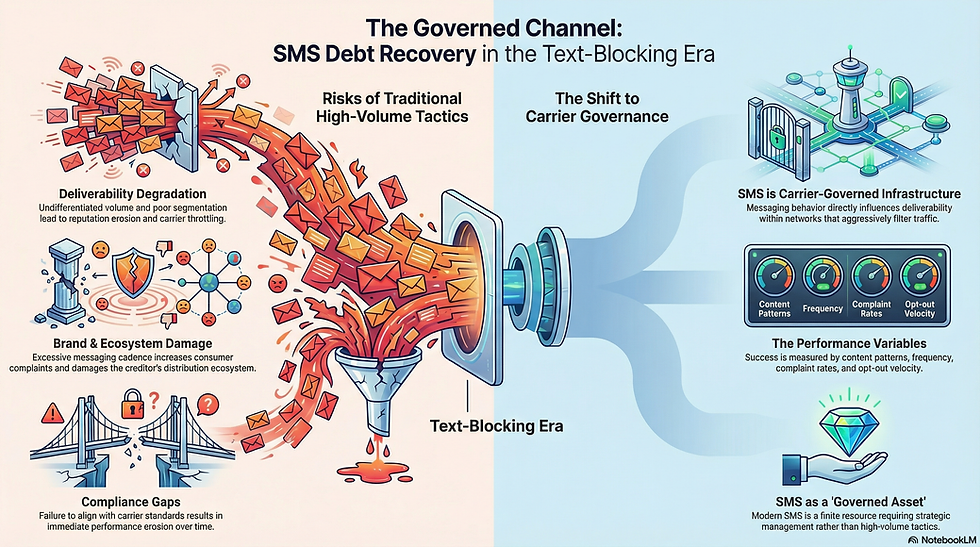
In a text-blocking era:
Undifferentiated high-volume messaging erodes sender reputation.
Poor segmentation accelerates carrier throttling.
Compliance gaps translate into deliverability degradation.
Excessive cadence increases consumer complaint exposure.
For telecom creditors, this creates dual risk: reduced recovery effectiveness and brand damage within your own distribution ecosystem. Agencies that fail to recognize SMS as a governed asset — not an unlimited channel — will see performance erosion over time.
What Adaptation Actually Looks Like
Recovering telecommunications debt today requires agencies to move from channel-driven execution to decisioning-driven execution.
1. SMS as a Scarce Resource
Leading agencies treat SMS capacity as finite. Messaging intensity is calibrated using predictive scoring models rather than applied uniformly across portfolios. Higher-propensity accounts, particularly those demonstrating liquidity signals or credit-sensitivity events, may warrant temporary SMS intensity increases. Lower-probability segments are engaged through moderated digital cadence, voice outreach, and structured physical mail — preserving sender reputation for high-yield opportunities. This is disciplined allocation, not selective pursuit.
2. Trigger-Based Precision Instead of Volume
Sophisticated telecom recovery strategies layer bureau monitoring — including mortgage inquiries, utilization reductions, and other credit behavior triggers — over a base scoring framework. When a consumer applies for a mortgage, for example, credit sensitivity increases. When paired with improving utilization signals, propensity to resolve outstanding balances rises materially. In a modern framework, that trigger does not generate random outreach — it activates a targeted, time-bound strategy adjustment. SMS cadence may increase briefly. Mail may escalate. Voice engagement may accelerate.
Just as importantly, message content can correspond directly to the trigger event itself. If a mortgage inquiry is detected, outreach may reference the importance of credit profile optimization and timely resolution. Content alignment increases relevance. Relevance increases response. And higher response rates reduce the need for excessive volume.
Trigger intelligence allows agencies to send fewer, more effective messages — protecting both performance and deliverability.
3. Compliance as a Deliverability Strategy
In telecom debt collection, compliance architecture now directly influences channel viability. Continuous bankruptcy scrubs, SCRA monitoring, deceased checks, and litigious flags are no longer only regulatory safeguards — they are sender reputation safeguards. Improper outreach does not just create legal exposure; it degrades carrier trust scoring.
Agencies must integrate consent tracking, opt-out processing, and suppression logic into automated workflows in real time. Telecom creditors should expect nothing less.
4. The Reintegration of Physical Mail
In a filtering-heavy environment, physical correspondence regains strategic importance.
Escalating notice sequences, validation letters, and letter-on-contact protocols reinforce seriousness of delinquency and provide durable documentation. Mail offsets digital friction and ensures continued engagement when SMS volume must be moderated. Agencies that abandoned disciplined mail strategy in favor of digital convenience are now recalibrating.
The Leadership Imperative
Telecom networks evolved by enforcing disciplined traffic management and intelligent routing. Debt collection agencies operating within those networks must adopt the same philosophy. Recovering telecommunications debt in the modern era requires strategy calibration, governance discipline, and channel orchestration — not message volume.
Telecom creditors who align with adaptive, intelligence-driven recovery partners will protect both revenue performance and network integrity. Those who do not will experience gradual degradation disguised as normal variance.
The text-blocking era is not temporary friction. It is a structural shift. The agencies that lead in telecom debt collection will be the ones who adapt accordingly.
Strengthen Your Telecom Recovery Strategy
If your organization is evaluating how collection partners are adapting to carrier-controlled messaging environments, now is the time to reassess strategy.
Explore how Magellan Debt Recovery approaches telecom debt collection with calibrated channel governance, trigger-based decisioning, and disciplined compliance architecture.
Learn more about our Telecom Debt Collection services.


Comments